
Epoch Converter
The current epoch time, live, and any epoch value as a human date.
Works in your browser. Nothing you type is sent to us.
Timestamp to date
Seconds, milliseconds, microseconds and nanoseconds are told apart by their length.
Date to timestamp
Converted in your browser with your device's clock and time zone data. Nothing is sent to us.
Epoch Converter at a glance
- Price
- Free
- Data sent to us
- None, it runs in your browser
- Sign-up
- Not needed
- Reads
- Unix time in s, ms, µs, ns, or an ISO date
- Gives
- Date in any zone, ISO 8601, RFC 2822, relative, week
- Zones
- Every zone your browser knows
How to use Epoch Converter
- Paste the timestampPut the number in the Timestamp box. The unit is read from its length and the date appears in every form, in your zone and UTC.
- Pick a zoneChoose Show in to see the same moment where someone else is. Copy any line with its button.
- Or go the other waySet a date, a time and the zone it is in under Date to timestamp, and copy the seconds or milliseconds.
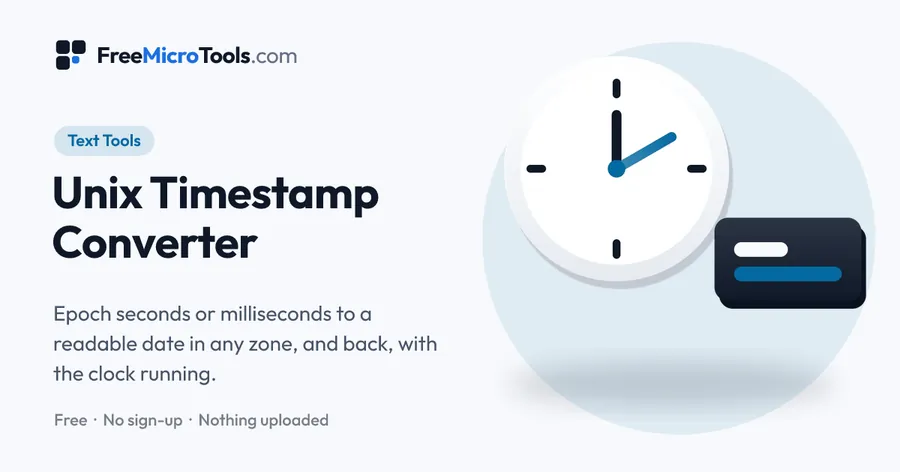
The current epoch time in seconds and milliseconds updates every second at the top, with a copy button. Paste any epoch value below to read it as a date in your zone, in UTC and in any other zone, with the ISO and RFC forms and how long ago it was; the unit is read from the number's length. Set a date and time to get its epoch value. Everything runs in your browser.
How it works
Epoch Converter is a web page that does its work on your own device. Everything you type or choose is worked out by your browser and never sent to a server, so nothing is stored and there is nothing to delete. There is no account, no sign-up and no limit on how often you use it.
Epoch and Unix time
Epoch time and Unix time are the same thing: seconds since the Unix epoch, 1 January 1970 UTC. Some systems count milliseconds from the same point, which is thirteen digits instead of ten.
Questions
When does epoch time run out?
Systems that store it as a signed 32-bit number overflow on 19 January 2038 at 03:14:07 UTC, which is why most have moved to 64-bit. The converter handles dates far beyond that.
Other shortcuts
Unix Timestamp Converter · Timestamp to Date
More
More Text tools
See all →
Base64 Encoder and Decoder
Text ToolsBase64 both ways: text or a file in, text, a data URI or a file out, with nothing sent anywhere.
JSON, YAML and XML Converter
Text ToolsConvert JSON, YAML and XML into one another as you type, with the errors pointed out, on your device.

Character Counter
Text ToolsCharacters, words and bytes as you type, checked against the limits that matter, counted the way each platform counts.