
Amazon FBA Calculator
See what Amazon takes from an FBA sale, from the size of the box up, and what you keep.
Works in your browser. Nothing you type is sent to us.
The product
The package, ready to ship
What it costs you
| Line | Amount |
|---|
For Fulfillment by Amazon in the United States. Worked out in your browser; nothing you type is sent to us. Not created by, endorsed by or affiliated with Amazon.
Amazon FBA Calculator at a glance
- Price
- Free
- For
- Fulfillment by Amazon sellers in the United States
- Fees covered
- Referral, FBA fulfillment, fuel surcharge, storage, closing, per-item
- Also works out
- Size tier, shipping weight, profit, margin, ROI, break-even and target price
- Amazon login
- Not needed
- Data sent to us
- None, it runs in your browser
How to use Amazon FBA Calculator
- Choose the category and pricePick the category the product sells in and type the selling price. The line under the list shows the referral fee that applies.
- Measure the packageType the length, width and height in inches and the weight, as the product will arrive at Amazon, packaging included. The box underneath names the size tier and the weight Amazon will charge for.
- Add what it costs youType what you pay for one unit and what it costs to get one to Amazon. Open More options for holiday peak rates, storage months, advertising and the Individual plan.
- Read what you keepThe fee list shows every charge; You keep shows the profit per unit, the margin, the return on what you spent, the break-even price and the price needed for the profit you want.
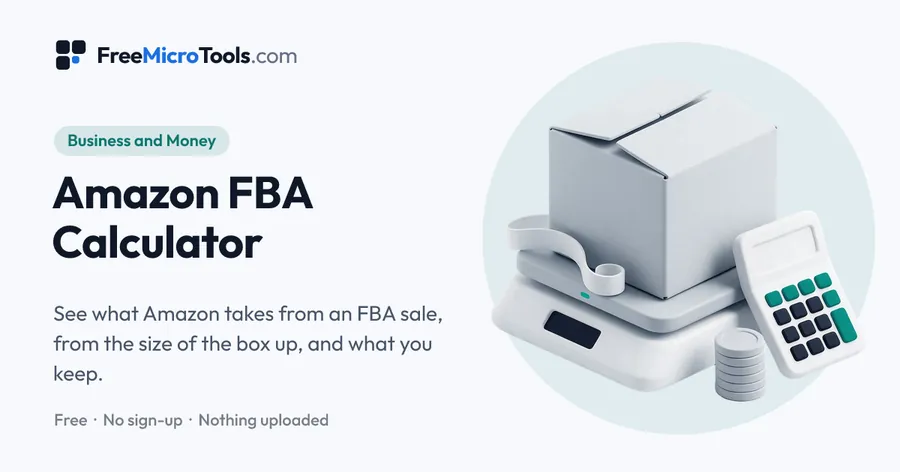
Type the selling price, the size and weight of the packaged product and what it costs you, and see what Amazon takes from one FBA sale: the referral fee at the category's own rate, the FBA fulfillment fee for that size tier, weight and price band, the fuel and logistics surcharge, storage, and the closing fee on media. Before any money, it tells you which size tier Amazon will put the package in and which weight it will charge for, the one on the scales or the dimensional one, because a box that is big for its weight is the most common reason an FBA fee is higher than expected. Underneath is what you keep per unit, with the margin, the return on what you spent, the break-even price and the price to charge to keep a particular amount. The rates come from Amazon's own Seller Central help pages for the United States, including the holiday peak rate card, and the page shows the date they were last checked.
How it works
Amazon FBA Calculator is a web page that does its work on your own device. Everything you type or choose is worked out by your browser and never sent to a server, so nothing is stored and there is nothing to delete. There is no account, no sign-up and no limit on how often you use it.
What Amazon takes from an FBA sale
Two fees land on every unit Amazon ships for you, and they are worked out in completely different ways:
- Referral fee: a percentage of the selling price, set by the category. Most categories pay the same rate, a few pay much less, and some change rate with the price. Amazon never takes less than a small minimum.
- FBA fulfillment fee: a fixed amount for picking, packing and delivering the unit. It has nothing to do with the category. It depends on the size and weight of the package, on whether the item is clothing or dangerous goods, and on which of three price bands the item sells in.
On top of the fulfillment fee Amazon adds a fuel and logistics surcharge, and from mid-October to mid-January it uses a dearer holiday rate card. Storage is charged by the cubic foot for every month the unit sits in a fulfillment centre, at about three times the usual rate from October to December. Books, music, films, software and video games also pay a closing fee on each one sold. The rates are the ones Amazon publishes in its Seller Central help pages for the United States, including the 2026 FBA fulfillment fee rate card and the referral fee table, and the date they were last read off those pages is shown under the answer.
Why the box matters as much as the product
Amazon sorts every package into a size tier, from Small standard-size up to Extra-Large, by its longest, middle and shortest sides and its weight. Then it charges for the heavier of two weights: what the package weighs on the scales, and its dimensional weight, which is the length times the width times the height in inches, divided by 139. A light product in a roomy box is charged as if it were heavy. Only the smallest tier and items over 150 lb go by the scales alone.
That is why the calculator tells you the size tier and the weight Amazon will charge for before it shows any money. If the second weight is the larger one, a smaller box lowers the fee, often by more than haggling a few cents off the unit cost would. Shaving the shortest side to three quarters of an inch, for an item under a pound, moves it into the cheapest tier of all.
Prices where you keep less by charging more
The fulfillment fee steps up when the price reaches $10 and again above $50, and a few categories change their referral rate at a price of their own, on the whole price rather than just the part above the line. So just past one of those lines you can keep less than you did just below it. The break-even and target prices take this into account: they give the lowest price that really does leave the amount you asked for.
What this tool does not do
- It covers Fulfillment by Amazon in the United States. Other Amazon stores have their own rate cards, and orders you ship yourself pay no fulfillment fee.
- It leaves out fees that depend on your own account rather than on the product: the inbound placement fee, the low-inventory-level fee, the storage utilization surcharge and aged inventory surcharge, returns processing, and the monthly Professional plan subscription. Put a per-unit allowance for them under Anything else you pay.
- It does not apply the discount for items that ship in their own packaging, the extra fee for lithium batteries, or the Overmax handling fee on very large items; it tells you when that last one applies.
- It does not sign in to Amazon, and it does not work out income tax on the profit.
Amazon measures each product itself and uses its own figures. Check the size tier and fees against the Fee Preview report in Seller Central before ordering stock around them.
What it does
- Finds the size tier from the package's three sides and weight, using Amazon's 2026 definitions
- Uses dimensional weight when Amazon would, and tells you when a smaller box would cost less
- FBA fulfillment fees for most products, clothing and dangerous goods, in all three price bands
- Normal and holiday peak rate cards, with the fuel and logistics surcharge shown on its own line
- Referral fees for every category, including the ones that change with the price, and the minimum fee
- Storage by the cubic foot for the months you expect it to sit, at the right season's rate
- Profit, margin and return on what you spent, per unit
- Break-even and target prices that allow for the fee jumps at $10 and $50
- Rates from Amazon's published Seller Central pages, with the date shown
Questions
How much does Amazon take from an FBA sale?
Two main fees. The referral fee is a percentage of the selling price set by the category: 15% for most, with a $0.30 minimum. The FBA fulfillment fee is a fixed amount for the package's size tier and weight, which for a standard-size item sold between $10 and $50 runs from $3.32 for a very small, light item to $6.67 at 3 lb, before a 3.5% fuel and logistics surcharge. Storage is charged on top by the cubic foot. The rates are in Amazon's 2026 FBA fulfillment fee rate card and its referral fee table, and this calculator shows the date they were last checked.
How does Amazon decide the size tier?
From the packaged product's longest, middle and shortest sides and its weight. Small standard-size is 16 oz or less and no more than 15 by 12 by 0.75 inches. Large standard-size is up to 20 lb and 18 by 14 by 8 inches. Beyond that come Small Bulky, Large Bulky and Extra-Large, which also look at the length plus the girth. The definitions are on Amazon's product size tiers page. Type the measurements and the calculator names the tier.
What is dimensional weight, and when does Amazon use it?
Dimensional weight is the package's length times its width times its height in inches, divided by 139. For every size tier except Small standard-size and items over 150 lb, Amazon charges for whichever is greater, the dimensional weight or the weight on the scales. For bulky and extra-large items it treats the width and height as at least 2 inches. See Amazon's dimensional weight page. The calculator tells you which weight is being charged, so you can see when a smaller box would cut the fee.
Why does the FBA fee change at $10 and $50?
Amazon has three columns on its rate card. Items priced under $10 get its Low-Price FBA rates, which are lower. Items from $10 to $50 pay the standard rate, and standard-size items over $50 pay a little more. So an item at $9.99 can leave you more than the same item at $10.50. The break-even and target prices in this calculator allow for that.
What is the fuel and logistics surcharge?
A 3.5% surcharge Amazon has added to FBA fulfillment fees in the United States since 17 April 2026. It is worked out on the fulfillment fee, not on the selling price, and the calculator shows it on its own line.
When do holiday peak FBA fees apply?
From 15 October 2026 to 14 January 2027, Amazon uses a dearer fulfillment rate card, and the surcharge applies to those rates too. Storage is also dearer from October to December. The calculator switches to the peak rates by itself during those dates, and you can choose them under More options at any time to plan ahead.
How are FBA storage fees worked out?
By the cubic foot, per month, on the space your units take up: $0.78 for standard-size items from January to September and $2.40 from October to December, with lower rates for oversize items and higher ones for dangerous goods. The calculator multiplies the package's volume by the rate and by the number of months you expect a unit to sit. Sellers with a lot of slow stock may also pay a storage utilization surcharge, which is not included. See Amazon's monthly inventory storage fees page.
What fees are not included?
Fees that depend on your account rather than on the product: the inbound placement fee, the low-inventory-level fee, storage utilization and aged inventory surcharges, returns processing, and the $39.99 monthly Professional plan. It also leaves out the discount for items that ship in their own packaging, the lithium battery fee and the Overmax handling fee. Put a per-unit allowance under Anything else you pay.
Is this the same as Amazon's Revenue Calculator?
It works from the same published rates, but it needs no Seller Central login and no existing listing, so you can check a product idea before you have sourced it. Amazon measures each product itself, so once a product is in stock, check the Fee Preview report in Seller Central for the figures it is actually using.
Is this calculator connected to Amazon?
No. It asks for no Amazon login, reads nothing from your account and sends nothing anywhere. Everything is worked out in your browser. Amazon and FBA are trademarks of Amazon.com, Inc. or its affiliates, and this tool is not created by, endorsed by or affiliated with Amazon.
More
More business and money
See all →
GST Invoice Generator
Business and MoneyMake a GST tax invoice with the tax worked out, and download it as a PDF.

Invoice Generator
Business and MoneyFill in a form, see the invoice as you type, and download it as a clean PDF.
Business Plan Template
Business and MoneyA guided business plan you fill in online, then download as Word or PDF.